Stories
The Ambler Kitchen With the 100-Amp Panel: What Old Wiring and Plaster Do to a Remodel Budget
The number first: in an Ambler, Fort Washington, or Upper Dublin home built before about 1960, plan on $5,000–$20,000 of your kitchen budget going to things you'll never see. Electrical service, plaster, plumbing stacks, and floors that aren't level. A $75,000 kitchen in a 1995 Blue Bell colonial is a $85,000–$95,000 kitchen in a 1928 Ambler Borough twin, with identical cabinets and counters. That isn't a reason not to do it. It's a reason to make sure the number is in the bid before you sign, not in a change order in week two.
Our office and warehouse are on East Welsh Road in Maple Glen, and we've been remodeling kitchens in the Borough and in the Upper Dublin neighborhoods around Fort Washington State Park since 2013. This is what those houses hand us, house by house.
The 100-Amp Panel
A homeowner in one of the Victorian-era homes near the center of Ambler Borough called us about a kitchen. Nice house, well kept, original in the ways that matter. The panel was 100 amps, mostly full, with a couple of circuits that had clearly been added by someone with more confidence than training. Their wish list included an induction cooktop, a wall oven, a beverage fridge, and the usual lighting.
An induction cooktop wants its own 40- or 50-amp circuit. A wall oven wants another. A microwave, dishwasher, disposal, and refrigerator each want a dedicated 20-amp circuit under current code, and counters need small-appliance circuits. That's six to eight new breakers before you've turned on a light. The panel simply didn't have the room. The fix was a 200-amp service upgrade, which in Ambler runs $3,000–$8,000 depending on the meter location and whether the utility drop needs to change. It's the most common hidden cost we see in pre-1960 kitchens across Montgomery County, and it's a permanent upgrade to the house that every future project benefits from.
Plaster Doesn't Patch Like Drywall
The next thing that house handed us was plaster over wood lath. Plaster walls are wonderful. They're dense, quiet, and they've lasted ninety years. They are also slower to demolish, they crack when you pull cabinets off them, and they can't be patched with a bucket of compound and a sanding sponge. Where we open plaster for electrical and plumbing, it gets repaired by someone who knows plaster or it gets replaced with drywall in that section, skim-coated to match. Either way, budget $2,000–$6,000 in a typical kitchen for plaster work, more if the ceiling is coming down to run new lighting.
One thing plaster does that people don't expect: it hides framing that isn't where a modern framer would put it. True-dimension 2x4s, studs on irregular centers, a header that isn't a header. We open a small inspection hole during the estimate so we can see what's there before we price it.
Nothing Is Level, and Cabinets Care
The kitchen floor in that Ambler house was an inch and a quarter out of level over twelve feet. That's normal for the era. It's also a problem when you're installing inset cabinetry with quarter-inch reveals and a slab of quartzite that expects a flat base. We corrected the floor with sleepers and a new subfloor before the cabinets went in, which added about $2,500 and two days. The alternative is shimming cabinets until the toe kicks look like a staircase, and we've seen plenty of that in kitchens we were hired to redo.
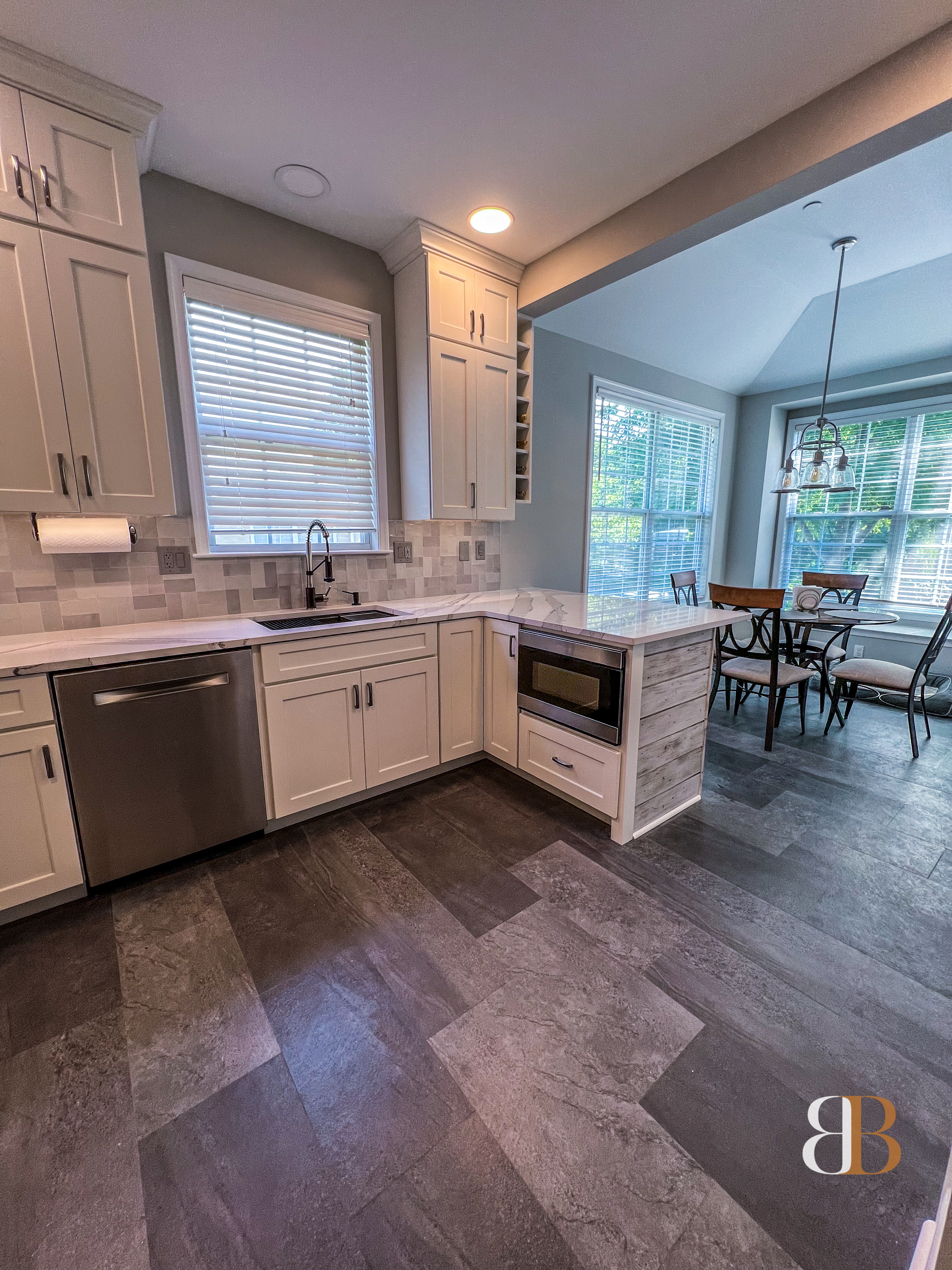
The finished kitchen took the same approach as our Stacked White & Gray Kitchen in the portfolio: soffits out, stacked cabinets to the ceiling with a clean crown, textured flooring, and a two-tone hood and peninsula so the room has character without trying too hard. In an old house, that proportion matters. Ceiling-height cabinetry makes a nine-foot Victorian ceiling look like an asset instead of a gap.
Cast Iron and Galvanized Pipe
Fort Washington and the older Upper Dublin colonials add one more item. If the kitchen shares a wall with the main drain stack, it's often cast iron, and the supply lines can be galvanized steel that's been quietly closing itself off for decades. If the wall is open anyway, replacing the section we can reach costs $2,500–$9,000 and removes a future emergency. If we don't touch it, we say so in the bid, so you know what you're keeping.
How to Bid for an Old House
This is where design-build earns its keep. A good bid for a pre-1960 kitchen in Ambler or Fort Washington has these things in it explicitly:
- A line for electrical service, either priced or marked "existing 200A confirmed."
- A plaster allowance with the square footage it assumes.
- Floor leveling priced or excluded in writing.
- Plumbing stack and supply replacement priced or excluded in writing.
- Permit and inspection coordination with Ambler Borough or Upper Dublin Township included, because both will inspect the electrical and plumbing.
If a bid is $15,000 lower than the others and none of those lines are in it, you've found the $15,000. Our guide to vetting a remodeler in the Ambler area covers the rest of the questions to ask, and the Montgomery County cost guide has the full tier breakdown.
Is It Worth It?
Yes, and not just because we're biased. The Ambler Borough and Fort Washington housing stock holds value precisely because it's the kind of house people want and nobody builds anymore. A kitchen that respects the house, with the hidden systems brought up to date, is the improvement buyers in this market actually pay for. The $10,000 you spend on a panel and plaster is the difference between a kitchen that looks new and a house that is.
We're about ten minutes from Fort Washington and we're minutes from Ambler. The consultation is free, and we'll open that inspection hole while we're there. Fill out our inquiry form, or read about remodeling in Ambler, Fort Washington, and our approach to luxury kitchen remodeling. Our kitchen remodeling in Ambler, PA page walks through what Borough and Upper Dublin homes add to a budget.
Frequently Asked Questions
How much does a kitchen remodel cost in Ambler, PA?
In 2026, most full Ambler kitchen remodels run $75,000–$110,000, with disciplined same-footprint projects starting around $55,000. In pre-1960 homes in the Borough or in Fort Washington, add $5,000–$20,000 for electrical service, plaster, plumbing, and floor leveling.
Do I need to upgrade my electrical panel for a kitchen remodel?
If you have 100-amp service and want induction or a large range, wall oven, and modern dedicated circuits, usually yes. A 200-amp upgrade runs $3,000–$8,000 in the Ambler area and is a permanent improvement to the house.
Can you keep plaster walls in a kitchen remodel?
Yes. Where we open plaster for wiring or plumbing, it's repaired by a plasterer or replaced with drywall and skim-coated to match. Budget $2,000–$6,000 for plaster work in a typical older kitchen.
Why is my kitchen quote higher than online cost estimates?
National guides average new and old homes together. Older Ambler and Upper Dublin homes need panel upgrades, plaster repair, floor leveling, and sometimes stack replacement, which a realistic local bid includes and a national average does not.
Who handles the permit for a kitchen remodel in Ambler Borough or Upper Dublin Township?
We do. Permit applications and all inspections with Ambler Borough or Upper Dublin Township are part of our standard scope, and both municipalities inspect electrical and plumbing on a full remodel.
Start Your Project
Ready to Stop Reading and Start Building?
The consultation is free. We'll visit your home, understand your vision, and show you what's possible.
Or call: 267-402-8758