Guides
Why Wayne and Villanova Homeowners Are Building Spa Bathrooms Instead of Buying Bigger Houses
Here's the math a lot of Wayne and Villanova homeowners are doing in 2026. Homes in Radnor Township regularly sell above $1.5 million. Moving costs six figures in transfer tax, commissions, and the premium for the next house, and the next house probably has a dated primary bath too. A spa-level primary suite in the house you already own runs $75,000–$110,000, takes seven to nine weeks on site, and gives you the one room that most changes how a house feels to live in. That's why the phone call we get most often from St. Davids, Strafford, and the older streets of Wayne isn't "should we move?" It's "what would it take to make this the bathroom we'd move for?"
We're a design-build firm in Ambler, about 28 minutes from Wayne via Route 30 or the Blue Route, and the 1920s and 30s Tudors, Georgian Colonials, and stone homes of Radnor Township are where much of our bathroom work happens.
What "Spa Bathroom" Actually Means
The phrase gets used for any bathroom with a nice tub. What we mean by it is a room designed around how you use it in the first and last twenty minutes of your day, with the systems to back it up. In practice it's five things, and the homeowners we've built them for tell us the same five are the ones they'd never give up.
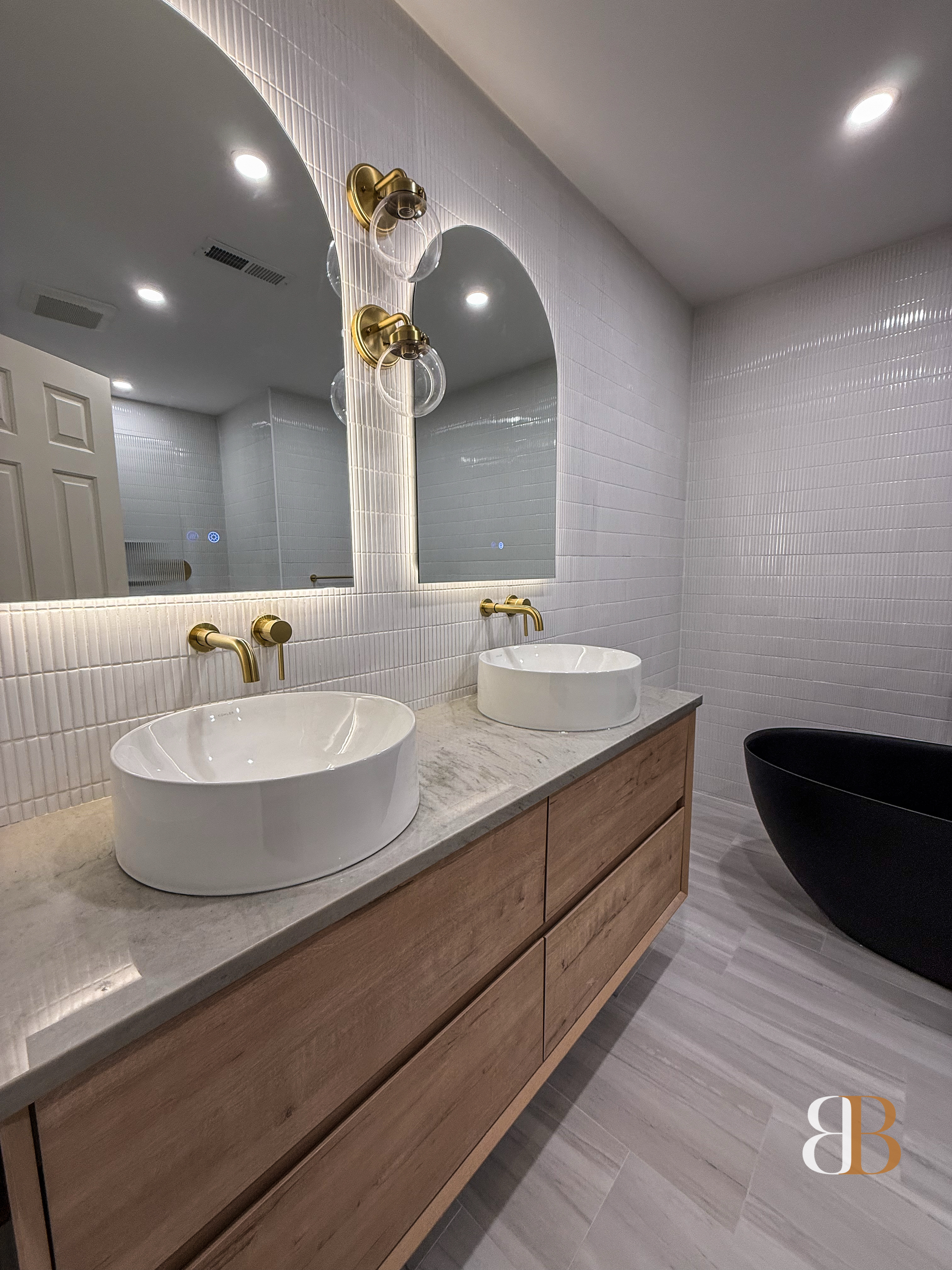
- A large curbless walk-in shower. Sixty inches or more, a linear drain, a bench, a niche, and a zero-threshold entry. Our Modern Dark Spa Master Bath is built around one: a zero-entry shower with accent tile wrapping the entire space, a floating vanity with a backlit mirror, and a matte black freestanding tub as the sculptural anchor.
- Steam. A properly sized generator, a sealed enclosure with a sloped ceiling so condensation runs down the wall rather than dripping on your head, and a transom or glass to the ceiling. This is the feature people are least sure about beforehand and most attached to afterward.
- Heated floors on a schedule. A radiant mat under large-format porcelain, on a programmable thermostat that has the floor warm at six and off by nine. In a stone-foundation Tudor, this is the difference between a beautiful room and a room you use.
- A real vanity wall. Two sinks, drawers rather than doors, integrated lighting at face height, and enough counter that two people don't negotiate. Custom or premium semi-custom.
- A tub only if you'll use it. We ask. About half of Wayne homeowners want the freestanding tub for the room's composition and use it a few times a year; the other half would rather have the space in the shower. Both are right. Don't build a tub for a hypothetical buyer.
What a Wayne Tudor Adds to the Project
The Hartford family's 1931 Tudor on our Wayne page is the reference: a herringbone marble floor that took three days to lay, in a house with the arched doorways, slate roof, and plaster walls that make Radnor Township what it is. Homes of that era hand every bathroom project the same list. Cast-iron drain stacks worth replacing while the wall is open ($2,500–$8,000). Plaster that gets repaired by a plasterer. Walls that need furring plumb before frameless glass. Undersized joists that get sistered before a stone floor or a full tub goes on them. A panel that needs to go to 200 amps for a steam generator and radiant heat ($3,000–$8,000). Our companion piece on what Gladwyne and Bryn Mawr stone homes hand us walks through each one in detail. Budget $10,000–$20,000 for the house before the finishes, and it's why the Main Line's primary-suite range runs higher than Montgomery County's.
Where the Square Footage Comes From
Most 1920s–30s primary baths in Wayne and Villanova are too small for what we've described. The space is usually next door: an adjacent closet, a small dressing room, or a hall bath that's redundant now that the house has three others. Combining rooms is the norm, not the exception, in a spa suite project. Plumbing moves with it, at $8,000–$15,000 for the relocation, and that's already in the $75,000–$110,000 range. What we don't do is chase square footage with an addition; in Radnor Township that runs well into six figures and rarely beats what's achievable inside the existing walls.
Why Now Rather Than Later
Two reasons that have nothing to do with us. First, the alternative keeps getting more expensive: every year the next house costs more and the friction of moving stays the same. Second, the suite is the room you'll use every single day you own the house, and it's one of the two rooms buyers in this market pay for when you eventually sell. Our Main Line bathroom trends article covers what's being built in Wayne, Villanova, and Bryn Mawr this year, and our heated floors guide makes the case for the upgrade we'd never leave out.
Timing and Permits in Radnor
Design and selections take six to ten weeks, because custom vanities, stone, and steam equipment have lead times. Construction is seven to nine weeks for a full suite. Permits go through Radnor Township, which inspects plumbing, electrical, and structural work; we file, meet the inspectors, and close out inside our standard scope. If you want the suite finished before the holidays, the contract needs to be signed by late summer.
If you've been pricing houses because of a bathroom, price the bathroom first. The consultation is free and happens in your home. Fill out our inquiry form, or read more about luxury bathroom renovations in Wayne and Villanova, remodeling across the Main Line, and our approach to custom bathroom renovations. See our bathroom remodeling in Villanova, PA page for Radnor Township specifics and investment ranges.
Frequently Asked Questions
How much does a spa bathroom remodel cost in Wayne, PA?
In 2026, a spa-level primary suite in a Wayne or Villanova home runs $75,000–$110,000, including a curbless walk-in shower, steam, heated floors, a custom double vanity, and the structural and plumbing corrections a 1920s–30s house requires. A full primary bath without steam or layout changes runs $55,000–$85,000.
Is a steam shower worth it?
Among the homeowners we've built them for, it's the feature they were least sure about beforehand and most attached to afterward. It requires a properly sized generator, a sealed enclosure with a sloped ceiling, and a dedicated circuit, which is why it belongs in the plan from the start rather than as an add-on.
Should I include a freestanding tub in my primary bathroom?
Only if you'll use it. About half of our Main Line clients want the tub for the room's composition; the other half prefer the space in the shower. Both are fine choices, and a tub built for a hypothetical future buyer is rarely a good use of $5,000–$15,000 and forty square feet.
Is it better to remodel my bathroom or move to a bigger house on the Main Line?
When the house has good bones and the primary bath is the main frustration, a $75,000–$110,000 suite usually beats the transaction costs and premium of moving in Radnor Township, where homes regularly sell above $1.5 million. We'll tell you honestly if the house can't support what you want.
How long does a spa bathroom remodel take?
Six to ten weeks of design, selections, and ordering, then seven to nine weeks on site. Custom vanities, stone, glass, and steam equipment drive the schedule more than labor does.
Start Your Project
Ready to Stop Reading and Start Building?
The consultation is free. We'll visit your home, understand your vision, and show you what's possible.
Or call: 267-402-8758